Data centers are an essential part of the infrastructure that supports our digital lives, but the language used to describe them isn’t always familiar to people outside the industry.
From power requirements and cooling systems to the way facilities are designed and operated, understanding some of the terminology can help make sense of how data centers work and the infrastructure they depend on.
This glossary explains 20 commonly used industry terms, what they mean and why they matter.
Power & Infrastructure
Critical IT Load
The amount of power available to the computing equipment within a data center, usually measured in megawatts (MW).
This is different from the facility’s total power requirement, which also includes electricity used for cooling, lighting and other building systems. Understanding that distinction helps explain why a data center needs more power than the servers inside it consume.
Megawatt (MW) and Megavolt-Ampere (MVA)
Two units commonly used to describe electrical power and capacity.
A megawatt (MW) measures real power: the electricity doing useful work. A megavolt-ampere (MVA) measures apparent power, which represents the combination of real power and reactive power in an alternating-current electrical system.
Data center capacity is often described in MW, while substations and other electrical infrastructure may be rated in MVA. The two figures are related but are not directly interchangeable.
Grid Connection
The physical connection between a data center and the electricity network that supplies its power.
Establishing a grid connection can involve new substations, transmission infrastructure and coordination with utility providers. The time required to secure and deliver that power is often called Time to Power, and it can influence when a new data center becomes operational.
Substation
An electrical facility that transforms electricity from one voltage level to another, allowing power from the wider grid to be distributed at levels suitable for a data center.
Large data center campuses may have a dedicated on-site substation to support their power requirements. Such substations form part of the electrical infrastructure needed to deliver reliable power.
Onsite Power Generation
The production of electricity at a data center or its associated campus, rather than relying entirely on power supplied by the wider electricity grid.
Onsite generation can use technologies such as natural gas turbines, reciprocating engines or fuel cells to provide power for normal operations, either independently of the grid or alongside it.
This approach can help data centers secure additional power capacity where grid availability is limited or connection timelines are lengthy. However, the choice of technology also introduces considerations around fuel supply, emissions, noise and local infrastructure.
Design & Operation
Rack Density
The amount of electrical power used by the equipment housed in a single server rack, typically measured in kilowatts (kW).
Traditional server racks have generally required relatively modest amounts of power, while those supporting AI and other high-performance computing workloads can exceed 50–100kW per rack.
Higher rack densities place greater demands on a data center’s electrical and cooling systems, influencing how facilities are designed and operated.
Data Hall
A dedicated space within a data center that houses servers and other IT equipment, supported by the power, cooling and network infrastructure it requires.
A data center may contain several data halls, each designed to accommodate different equipment or operational requirements. Dividing a facility into separate halls also enables capacity to be brought into service in stages.
Cooling
Liquid Cooling
A method of removing heat from computing equipment using liquid rather than relying solely on air.
Liquid transfers heat more efficiently than air, making it particularly useful for high-density computing environments, including those supporting AI.
There are two main approaches. Direct-to-chip cooling circulates coolant through plates attached to processors, while immersion cooling submerges computing equipment in a specially designed, electrically nonconductive fluid.
Closed-Loop Cooling
A cooling system that continuously recirculates water or another coolant rather than relying on a constant supply of fresh water.
Unlike evaporative cooling systems, which consume water as part of the cooling process, closed-loop systems can significantly reduce water consumption.
This distinction is particularly important in areas where water availability is limited or where the environmental impact of a data center development is of concern.
Resilience
Redundancy (N+1 and 2N)
The provision of additional equipment or systems that allow a data center to continue operating if a component fails or requires maintenance.
Redundancy is often described using terms such as N+1 and 2N. In this context, N represents the capacity needed to support normal operations. N+1 provides one additional component beyond that requirement, while 2N provides a second, independent system capable of supporting the full load.
These arrangements help reduce the risk of interruptions to critical services.
Uninterruptible Power Supply (UPS)
A system that provides immediate, temporary power if the normal power supply is interrupted.
Typically using batteries, a UPS keeps IT equipment operating during the short interval before backup generators take over. It also helps protect sensitive equipment from certain fluctuations in the power supply.
Backup Generators
On-site equipment that generates electricity when the normal power supply is unavailable.
Backup generators provide an additional layer of resilience, enabling data centers to remain operational during power outages. They are commonly powered by diesel, although alternative fuels and technologies are also being explored.
Generators are periodically tested to ensure they operate when needed. Their location, noise and emissions are important considerations in data center design, particularly in relation to surrounding communities.
Development & Delivery
Metro, Hyperscale & Gigascale
Terms used to describe different types and scales of digital infrastructure.
Metro data centers are typically located in or near major metropolitan areas, providing connectivity and computing capacity close to the businesses, networks and users they serve. They are particularly suited to applications where fast data transmission and low latency are important.
Hyperscale refers to very large data centers designed to support extensive computing and storage requirements, typically for major cloud and technology companies. These facilities can require tens or hundreds of megawatts of power.
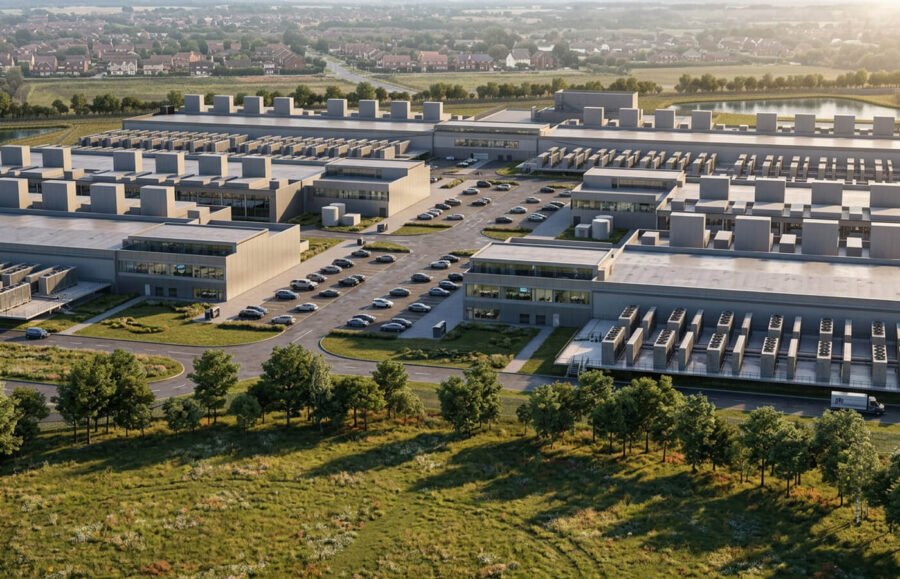
Gigascale describes development on an even larger scale, often involving multiple data center buildings, substantial power infrastructure and capacity for long-term expansion. These campuses can support hyperscale and high-density computing requirements, including AI.
Build-to-Suit
A data center designed and constructed to meet the specific requirements of an individual customer.
This approach allows power, cooling, security and other elements of the infrastructure to be tailored to the customer’s technical and operational needs from the outset.
Commissioning
The process of testing and verifying that a data center’s systems operate as intended before the facility enters service.
Commissioning covers critical infrastructure such as electrical distribution, cooling, backup power and monitoring systems. It includes testing individual components and checking how systems work together, including under simulated failure conditions.
The process helps confirm that a facility can operate safely and reliably before IT equipment is brought into use.
Connectivity & Latency
Connectivity refers to the network infrastructure that links data centers to other facilities, businesses and the wider internet, typically through high-speed fiber-optic cables.
Latency is the time it takes for data to travel between two points on a network, usually measured in milliseconds. Lower latency means faster response times, which can be particularly important for applications requiring real-time data processing.
The quality of a data center’s connectivity and its proximity to users and other networks can influence latency, making location an important consideration in data center design.
Sustainability
Power Usage Effectiveness (PUE)
A measure of how efficiently a data center uses energy, calculated by dividing the facility’s total energy consumption by the energy consumed by its computing equipment.
A PUE of 1.0 would mean all the energy consumed by the facility is used by its computing equipment, with none required for cooling, lighting or other supporting systems.
The closer the figure is to 1.0, the more efficiently the facility uses energy to support its computing operations, although PUE does not measure total energy consumption or carbon emissions.
Water Usage Effectiveness (WUE)
A measure of how much water a data center uses in relation to the energy consumed by its computing equipment, typically expressed in liters per kilowatt-hour (L/kWh).
WUE helps assess the water demands of data center operations, particularly the water used by cooling systems.
Lower WUE figures indicate less water consumed relative to computing energy use, making it a useful measure when evaluating water efficiency.
Embodied Carbon
The greenhouse gas emissions associated with producing, transporting and installing the materials used to construct a data center.
Materials such as concrete and structural steel can account for a significant proportion of these emissions.
Embodied carbon is distinct from the emissions associated with operating a facility and is an important consideration when assessing the environmental impact of data center construction.
Renewable Energy Certificates (RECs)
Certificates that represent the environmental attributes of electricity generated from eligible renewable energy sources, such as wind or solar power.
Each certificate typically represents one megawatt-hour (MWh) of renewable electricity generated and supplied to the grid.
Organizations can purchase and retire RECs to support renewable electricity claims, even when the electricity physically delivered to their facilities comes from a grid supplied by a mixture of energy sources.
Beyond the Definitions
Understanding the terminology is a useful starting point for more informed conversations about data centers, from how they are designed and operated to the infrastructure they require and their impact on surrounding communities.
As digital infrastructure becomes a more familiar part of our built environment, making its technical language accessible helps people better understand the facilities themselves and the considerations involved in developing and operating them.